War

During this season of Lent, the Lutheran pastor and I have alternated offering services on Wednesday nights.  One week we have soup supper at our church and she leads.  The following week we have supper at her church and I lead.  Each week has had a different theme paired with a scripture.  This week my passage was from Philippians 4:8-9: Finally, brothers and sisters, whatever is true, whatever is noble, whatever is right, whatever is pure, whatever is lovely, whatever is admirable—if anything is excellent or praiseworthy—think about such things. Whatever you have learned or received or heard from me, or seen in me—put it into practice. And the God of peace will be with you.

But the topic this scripture was linked to was justice and peace in the midst of violence.  I pondered how in the world I would relate those two things, especially after weeks now of watching as Ukraine suffers unimaginable destruction, unfathomable loss.  But then I began to think of the videos I had seen of various Ukrainian musicians playing their instruments in the midst of bombed out buildings, their surroundings littered with the carnage of war.  I recalled an image of a group gathered in a shelter in prayer.  There was one video of refugees dancing when they reached a country that welcomed them with food and toys for the children.  The most touching one was of a Ukrainian child, who had reached another country, drawing flowers on the sidewalk with chalk.  She said “This is how I calm myself.” She was eight. 

I spoke that night of how “thinking on these things,” the lovely things, the admirable acts, enables us to respond to the ugliness, the greed, the hate and all that grows out of it in this world, with a spirit that seeks to uplift.  Mr. Rogers said to “look for the helpers.”  When we do, we are often inspired to “join the helpers…..be the helpers.”  May it be so.

May we be bearers of hope, the “wait staff” of Hope’s Café for each other and all those we encounter.  Shalom, Kate

Hope’s Café Bonus:

Olha Rukavishnikova. Violinist. Fighter.

1 day ago

Friends! Thanks to everyone for the kind words and support! From the first day of the vile attack of Russian Nazis on my country, I have been in the ranks of the Territorial Defense of Ukraine. Ordinary Ukrainians are fighting in our unit, not professional ones – managers, drivers, musicians, teachers. Although it’s not easy for us, since there is a lot missing in the squad, we believe that good will always triumph over evil, and we put all our strength into it! Glory to Ukraine!

Surprising Journeys

In my first job out of grad school, I had a colleague Mark.  Mark was married to June and I became friends with them both.  At a point where I had a roommate moving out, they suggested that their friend Phyllis needed a roommate while she finished her final semester of law school.  Phyllis and I met and agreed to share my apartment for the duration of her schooling. 

I really liked Phyllis and for a time, even after she graduated, moved back to her Colorado roots and married her longtime boyfriend Tom, we kept touch.   Mark and June had moved away and it seems like the last contact I’d had with Phyllis, she told me Mark and June had divorced.  Over time I lost contact with these friends I had so enjoyed.

In this day and age of social media and multiple ways to track down lost connections, I had an impulse last week to do a search for Phyllis on FB.  What popped up was her familiar face and a promotion for her book, Quantum Lite Simplified: How to Calm the Chaos .  If anything, I might have expected she was serving as a judge somewhere.  The book and its intriguing title were a surprise

Of course, I had to get the book, a very credible and readable effort, which flows so naturally it seems effortless.  Phyllis begins “with a brief history and explanation of how I got into quantum.  Parts 1-3 give you an understanding of energy, systems and chaos theory from a quantum perspective.”  The last half, parts 3-5, “offers a way to ‘be’ in chaos without ‘being in chaos’.”

Her book reveals much of her own evolution from lawyer to author.  I thought of other friends whose lives developed in such different directions from their starting point.  My friend Mary, for example, was a psychologist, later a Physicians Assistant, and now a creator of beautiful quilts and a teacher of quilt-making.  My life is testament as well, as I now pastor after years as a therapist.  And I really don’t think I’m finished.  I have wondered if there is another book lurking somewhere in my brain and heart.  It is now five years since Dream In Progress was published.  It was so much work but so much pleasure. 

My father was a newspaper printer from the time he apprenticed at 17 to the time he retired at 70.  He told me that, coming up in the depression, he was encouraged that whenever he got a job, he should always hang onto it.  And he did.  He shared with me once when I was a teen,  that he had in mind a story that he really thought about writing.  Years later I reminded him of that and told him if he would tell it to me, I would write it.  He said, with some resignation, that he didn’t remember it. 

Thankfully, there is more freedom now to pursue multiple avenues over the course of a lifetime.  May we have the courage of those like Phyllis, and avoid the regrets like those of my dear father, who surely had a worthy tale to tell.

 May we be bearers of hope, the “wait staff” of Hope’s Café for each other and all those we encounter.  Shalom, Kate

Hope’s Café Bonus:  “Life is about accepting the challenges along the way, choosing to keep moving forward, and savoring the journey.”
― Roy T. Bennett, The Light in the Heart

Geology is Boss

One of our guides on our recent trip to Yellowstone National Park told us that the geothermal features can shift and move over time.  She said that when they became problematic to a road,  the original response was to pave over them.  Eventually, they began to re-route the road or change planned construction, instead of attempting to “tame” the hot spring or geyser.  As she put it, “Geology is boss.”

I wonder how long it took them to come to that conclusion.  How often do we attempt to “solve” problems by administering the same “solutions” without the desired outcome?  As Albert Schweitzer is often quoted as saying, “Insanity is doing the same thing over and over and expecting different results.”

Mindless repetition whether paving over Mother Nature’s marvelous works to “maintain” the road or repeating the same behavior in our own lives that has proven itself unworkable, is like the hamster running on a wheel, expending lots of energy but getting nowhere. 

This topic is especially relevant to me and to all those in churches and other organizations that thrived in the 50s and 60s.  One problem lies in that these attempted solutions were formerly standard operating procedure which worked well in previous years.  So we turn to what we know, what has felt comfortable and are puzzled when it doesn’t work.   

 How does one stay vital in a culture that over time has shifted so dramatically?   “Work smarter, not harder” comes to mind.  Pay attention to what excites you, gets your blood pumping, a vision of your desired goal.  Then figure out the steps to reach it and evaluate as you go.

I was once part of a visioning process in a church that was seeking to revitalize itself, to develop new ways to relate in a meaningful way to the community.  We did a visualization exercise with the goal to imagine our church in the future.  One person said he saw the church dark and shuttered.  I was aghast.  I had seen in my image a group of children playing in the yard adjacent to fellowship hall being called in to supper where they joined their families, which seemed a bit farfetched in a church with no children.  Six or eight months later, however, we began to work with what was then called Interfaith Hospitality Network, where churches rotate opening their spaces to homeless families a week at a time.   The first night we served the network I was awestruck as I watched the children come in from playing outside to join their parents for the evening meal, just as I had envisioned it.

 There may always be naysayers to a vision and perhaps they have valid points to consider.  But it serves any organization to have enthusiastic people and leaders who can help focus that energy to pursue and carry out a vision. 

May we be bearers of hope, the “wait staff” of Hope’s Café for each other and all those we encounter.  Shalom, Kate

Hope’s Café Bonus:  Do One Thing Different by Bill O’Hanlon, describes a process of change making one small alteration at a time, another suggestion.  One change builds on another.

The Pandemic and Us

Backing my car out of the garage one day this week, I thought of how automatically I perform the actions it takes to drive, all the necessary steps embedded in my brain.

          However, I recall after my mother died, I went through a period where I could not recall how to operate the clothes dryer.  The appliance was suddenly mysterious, inscrutable, the result of the trauma of that loss. 

          Last week, I watched a program on Trauma on Our Bodies and Brains presented by clinical psychologist Dr. Betsey Stone.  She talked about the impact of months and months of the stress of various aspects of covid—uncertainty, restrictions, isolation, illness, death—on the brain.  In a time of fear, she said, our “lizard” brain (the amygdala) “hijacks” the blood supply from our “rational” brain (the prefrontal cortex).  We are actually receiving a reduced blood supply to the part of our brain that thinks rationally.  Because of this, we are less able to think clearly, to make sensible decisions, to evaluate danger, to regulate our emotions.  Dr. Stone attributes increased violence and lack of impulse control, such as that frequently demonstrated on airplane travel in recent months, to be due in part to this decreased blood supply. 

          The ongoing stress of living in this time of pandemic highlights a need for greater attention to caring for our bodies and our brains.  As Sid Garza-Hillman has said, “Caring for the mind is as important and crucial as caring for the body.  In fact, one can not be healthy without the other.”   (from Approaching the Natural:  a Health Manifesto)

May we be bearers of hope, the “wait staff” of Hope’s Café for each other and all those we encounter.  Shalom, Kate

Hope’s Café Bonus:  How to deal with stress and build resilience during the COVID-19 pandemic?

Increase your sense of control by keeping a consistent daily routine when possible — ideally one that is similar to your schedule before the pandemic.
⁃ Try to get adequate sleep.
⁃ Make time to eat healthy meals.
⁃ Take breaks during your shift to rest, stretch, or check in with supportive colleagues, coworkers, friends and family. (from CDC website). 

I would add to drink plenty of water.  I have read that under stress the body produces a thick, paste-like blood, making adequate circulation more difficult. 

My Montana Tiara

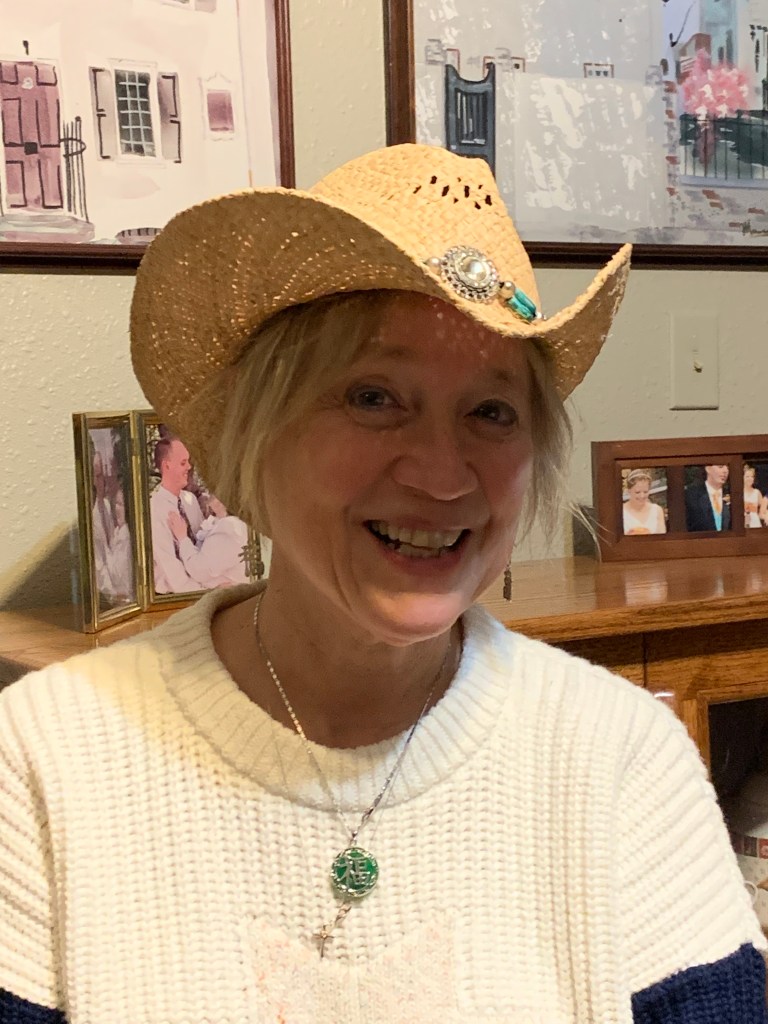
January 23 I was “installed” as pastor at Columbus Community Congregational Church.  It had been joked that it was going to be my “coronation.”  I responded in kind that I would “polish my tiara.”  My friend and colleague Meg was the speaker.  She carried the joke forward. Saying she was sure that I was too humble to actually bring a tiara, she pulled from a bag a lovely cowboy hat.  She proceeded to place it on my head, identifying it as my “Montana Tiara.”

The most amusing aspect of this for me, however, was how my attitude evolved about this event.  Initially, I thought “ho-hum, a necessary formality.”  But then I took more initiative in planning for the ceremony.  I asked Meg to speak.  I asked that the formalities be kept simple.  I decided to read a poem and sing a solo in response to my installation.  The day turned out to be a lovely celebration.  I thoroughly enjoyed myself.  Those who attended seemed to really appreciate the upbeat atmosphere of the ceremony. 

What difference might it make if we approached matters in another way?  Tasks that might otherwise  seem to be boring or drudgery or overwhelming, instead might become a challenge, an opportunity to take initiative to alter the situation. 

An extreme example is currently in the news of Lily Ebert, the 98 year-old Auschwitz survivor who wrote Lily’s Promise: How I Survived Auschwitz and Found the Will To Survive.  Much like Victor Frankl, who survived concentration camp  imagining himself as a professor teaching at a university, she made it her intention to live to tell her story. 

I don’t expect to ever experience anything as traumatic as those situations.  But I do know I sometimes I have an attitude that makes even ordinary tasks more difficult than they need to be.  And I know life can challenge us in ways we never expect.  My Montana Tiara serves to remind me that I choose my attitude and the approach I take in situations that present themselves to me. 

May we be bearers of hope, the “wait staff” of Hope’s Café for each other and all those we encounter.  Shalom, Kate

Hope’s Café Bonus:  My Montana Tiara!

When An Entire Generation Passes

              This week my Aunt “Pinkie” died, just short of her 97th birthday. I have no aunts or uncles left now.  Her five children are surely now experiencing that sense of being “orphaned.”

              Her given name was actually Betty.  In the way that names sometimes run in families, I had another “Aunt Bettie,” my mother was named Betty and my sister-in-law Elizabeth is known as Betty.  But Pinkie was more often known by her nickname due to her red hair. 

              My favorite memory of her occurred when I was about four or five years old.  My parents and I had gone to visit. Unlike my parents’ small home where my bed was located in my parents’ bedroom, I discovered at my aunt’s and uncle’s home, I was put to bed in a big bedroom by myself.  Even now, I can remember feeling scared and alone.  I began, first softly, then more loudly, to call out for my parents.  It seemed like my aunt suddenly appeared and recognized how distressed I was.  I don’t remember where I ended up, only that she was so understanding and immediately corrected the situation.

              My aunts and uncles were mostly peripheral during my growing up years.  I saw them mostly at family reunions whenever they occurred.  But somehow they provided a comfortable backdrop of caring relatives who always seemed happy to see me, predictably proclaiming how much I’d grown.  I can recall thinking, “Of course I’ve grown.  What did they expect?” 

              As one and then another has died, I am aware of how valuable even that limited amount of contact was. When I became an aunt at 17, I so valued my new role. I, too, am on the periphery of my nephews’ lives.  Yet one of my proudest moments was a few years ago when the oldest posted tribute to me on Face Book. 

              The slender threads of connection can be more meaningful than we know,  so much more solid than we recognize.

               May we be bearers of hope, the “wait staff” of Hope’s Café for each other and all those we encounter.  Shalom, Kate

              Hope’s Café Bonus:  I discovered if you google aunt that you will discover there is a national aunts and uncles day. (Who knew?):”National Aunts and Uncles Day is observed every July 26. Our aunts and uncles are unique parts of our family; they can be like a second set of parents, or great friends you happen to be related to.”

Connections

When I was a child, I was entranced by the notion of pioneer times.  I thought I would have liked the adventure of being a pioneer.  There are a lot of reasons I recognize now that I would not have adapted well to that kind of experience.  Being cut-off from easy communication would have been my downfall.  No phones!  No email! No Facebook!  No internet!  Now some people would say, that would suit them fine.  Certainly, the plethora of modern communication does become burdensome and unplugging periodically seems to serve our health.  And yet….

I think of a long-lost friend who tracked me down through an old phone number she got through my high school alumni association.  I recall a phone call I received once as I was just about to walk out of the office at the church I was pastoring in Florida, the caller having somehow gleaned from the internet that I was there.  She had been a client of my husband Terry when she was a teenager and just wanted to convey how well her adult life was going and to thank him.  And last week I discovered someone had left a message on my blog, yet another former client in search of Terry.  These kinds of connections strike me almost like wizardry.

People have applauded us for uprooting ourselves at this stage in our lives to move to Montana, trekking like modern day pioneers to a place where we had no established connections.  And, indeed, this was an adventurous thing to do, when staying put would have been the more reasonable course to take.  But I honestly don’t know how well we would be able to live with this choice were it not for zoom.  This morning we will zoom with a group back home, and again this evening with another group of home folks.  These are weekly rituals.  This is not to say we aren’t making new friends.  But the former ties sustain us.

May we be bearers of hope, the “wait staff” of Hope’s Café for each other and all those we encounter.  Shalom, Kate

Hope’s Café Bonus: Connection:  The energy that exists between people when they feel seen, heard and valued; when they can give and receive without judgement; and when they derive sustenance and strength from the relationship.— Brene Brown

Small Town Living

Our church sits next to the original building called, appropriately enough, The Little Stone Church.  It is sometimes rented out for showers, weddings, other events.  Last weekend it was rented for a craft show.  I went over to introduce myself and the organizer said, “Oh, yes.  I’ve heard all about you.”  The next day I conducted a memorial service where I was introduced to someone from out of town.  She said,“I’ve heard a lot about you”….Small Town Living

              We live close enough to the church for me to walk to work.  This week we had snow.  As I walked to work, I encountered someone blowing snow off what I assumed was his driveway.  I laughed and said, “I need to send you down the street to my house.”  He said, “Where to you live?”  Startled, I gave him my address.  “You live two doors down from my mother,” he replied.  I asked what he charged and he said, in a tone that bordered on embarrassment, “Oh, just whatever you want to pay me”…..Small Town Living.

              The next day I went back to pay him.  When I knocked at the door, to my amazement, Dick, a church member, answered.  It turns out the snow blower is a neighbor, who blows off the snow and shovels the sidewalk for Dick in return for some of Dick’s home-grown vegetables…..Small Town Living.

              I was told when I moved here that helping one’s neighbor is characteristic of this ranching and farming area.  If a farmer or rancher has encountered some problem or disaster, neighbors help out, knowing next time it could easily be you.  And you know that when your time comes, they will just as quickly come to your aid. 

              This awareness that we have some responsibility to others and that we engage in some mutual benefit by serving one another, seems to me to be lost in our current milieu.  So much of what is wrong in the world, boils down to a person or group of persons or a corporation, deeming their needs or desires supersede anything or anyone else’s needs or desires. 

              Years ago I read the book The Navigator, a novel with detailed a group of people who decided to establish their own colony, with no rules.  Anyone could do whatever they wanted.  They discovered this was really untenable.  There had to be some ground rules that made living together in community possible.  Rugged individualism is one thing.  To totally disregard the needs, rights and well-being of others is a totally different thing. May we seek always to be good neighbors and to cultivate community.

May we be bearers of hope, the “wait staff” of Hope’s Café for each other and all those we encounter.  Shalom, Kate

Hope’s Café Bonus:  If you google “Cultivating Community” you will find a group in Portland, Maine, organized to support ” teaching people sustainable farming practices and connecting them to the community through our food hub.” They “support and manage diverse urban growing spaces, enabling community members to grow their own food within city limits.”  They also “increase access to local, healthy foods for low-income consumers, providing affordable produce through CSA shares, farm stands, and mobile markets.”

Tempus Fugit

“Tempus Fugit”—Time Flies…..how well I know!  A year ago we were about to wrap up a near four-month stint of caring for our grandsons.  I returned to supply preaching while trying to figure out how to search for a call during covid.  Then when I least expected it, I got a call to, of all places, Montana, where I had never even considered going. Suddenly we were selling our house and moving.  Then last month we bought a house and so we have moved from our apartment into a home—right at the church season of Advent!  To complicate matters, we were without internet for a week and my printer crashed.   

All this is to say, Hope’s Café has been neglected!  I return to you today with the recognition that likely everyone reading this shares the experience of life being disrupted in ways you didn’t anticipate.  So I count on you to “give me some grace,” as I am fond of saying. While in the Christian tradition, grace is the free and unmerited favor of God, another definition is “an extended period granted as a special favor,” the response I am seeking for my delay. 

So, in return for the gift of your grace, I offer this:

Now is the time to know
That all that you do is sacred.

Now, why not consider
A lasting truce with yourself and God.

Now is the time to understand
That all your ideas of right and wrong

Were just a child’s training wheels
To be laid aside

When you can finally live
With veracity
And love.

Hafiz is a divine envoy
Whom the Beloved
Has written a holy message upon.

My dear, please tell me,
Why do you still
Throw sticks at your heart
And God?

What is it in that sweet voice inside
That incites you to fear?

Now is the time for the world to know
That every thought and action is sacred

This is the time
For you to deeply compute the impossibility
That there is anything
But Grace.

Now is the season to know
That everything you do
Is sacred.

– Hafiz

Hope’s Café Bonus: There is a PBS piece  from September 2019 on Joy Harjo, which I could not seem to copy the link to and make it work.   Ms. Harjo is an internationally renowned performer and writer of the Muscogee (Creek) Nation and has been the United States poet laureate.    She is from my native Oklahoma and later taught at my alma mater in Knoxville, TN.  Among many youtube videos of her, there is one available of her reading her poem “Grace.” I would encourage you to check it out.  😊

Irony

About three years ago I began to have some difficulty with my right leg.  Periodically I would get severe cramps in it, unlike any leg cramps I’d ever had.  Peripheral artery disease was ruled out in 2019.  I didn’t get a diagnosis and I dropped the matter.  In 2020 when the problem evolved from cramps to pain that was becoming more and more frequent, I decided to pursue this again.  Knowing that I was likely going to be accepting a pastorate and wanting to get the procedure taken care of before moving, I got a referral to a vascular clinic.    But there was a delay after the ball was dropped in the office where I had completed testing and gotten a diagnosis. Then, though insurance approved it, Medicare denied it.  The day before the movers came in August to move me to Montana, where I had in fact accepted a call to serve a church, I received a call.  The news? That Medicare had approved the process on appeal! Great—except that the move was about to ensue. 

So, now established with a new doctor in Montana, I began the process anew.  I got a referral almost immediately.  The new office was extremely efficient.  And, biggest surprise of all, the nurse practitioner  spent nearly an hour with me!  I got much more in-depth information than I had received in my pre-move appointment and was very impressed with the nurse practitioner.

I am reminded of the Sufi story “Good Thing, Bad Thing.  Who Knows?” which I first heard years ago.  The farmer’s horse runs away…oh no!  Then it returns with a second horse….oh good!  Then the farmer’s son falls off the horse and breaks his leg….bad thing!  Then a war breaks out and the son is ineligible for the draft because he is physically not able….good thing!  He doesn’t risk worse injuries or death.

I was so disgusted when I wasn’t able to get the surgery last summer. (Bad thing!) Now I am much more comfortable with the care I am getting.  (Good thing!)

When we look back at our lives, we likely all can point to experiences such as these.  In 2010, my position was cut from a hospice job I loved and expected to continue to retirement.  I was truly devastated.  But that led to my path towards ministry and a position I deeply love.  And my hospice experience is valuable in this new vocation. 

Ironic as some twists can be on our journeys, all these experiences contribute to the tapestries of our lives.  Think of it as “irony as gift.”

May we be bearers of hope, the “wait staff” of Hope’s Café for each other and all those we encounter.  Shalom, Kate

Hope’s Café Bonus: “No problem comes to you without a gift in its hands.”—Richard Bach